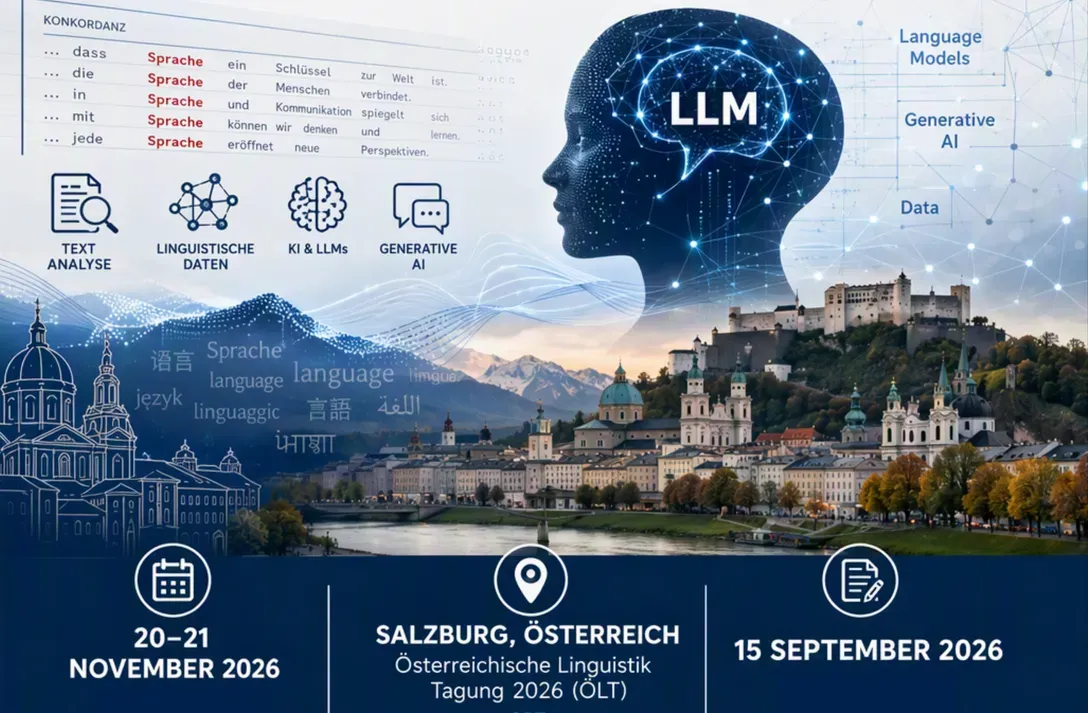
4th Austrian Meeting on Digital Linguistics
From tool-supported concordances to AI
When: Saturday, 21 November 2026, 9:00 a.m. to 6:00 p.m.
Where: This workshop is co-located with the Österreichische Linguistik Tagung (ÖLT2026, 20. - 21. November 2026), taking place at the University of Salzburg
Registration: closed.
Digital linguistics is a growing interdisciplinary field at the intersection of linguistics, information technology, and the social sciences. This is reflected by a growing number of new projects, publication series, and university courses. A central focus of digital linguistics is language data, i.e., digital artifacts that use human language as a form of expression. The range of these language data includes social media content, parliamentary transcripts, newspapers, and medieval manuscripts, among others. Such data are processed, annotated, analyzed, curated, shared, archived, and reused, among other activities. Also new technologies such as large language models (LLMs) and generative AI play a growing role in digital linguistics. Therefore, the topics covered in this workshop span from the creation of digital language resources (corpora, dictionaries, etc.), new methods (application of LLMs and generative AI), analysis of language data (e.g., semantic change detection, emotion and sentiment analysis), to the use of standards and research infrastructures, as well as methods for long-term archiving or reuse of language data.
As an established workshop series, supported by CLARIAH-AT, the “Fourth Austrian Meeting on Digital Linguistics” aims to highlight recent developments in the Austrian research landscape and beyond and to connect different projects in the field of digital linguistics, as well as the researchers involved. The workshop aims to (1) facilitate the exchange of methodological insights and the presentation of research results and (2) the creation of synergies through the mutual sharing of digital language resources.
Programme
09:00 - 9:15: Introduction by the Workshop Organizers
09:15 - 09:30: The Language of Feeling: Emotion Detection in Early Modern English Drama, Gretel Goh
09:30 - 09:45: Chancen und Grenzen der automatisierten Klassifikation homonymer Kommunikationsverben mit ModernGBERT 134M, Anna-Lena Randermann
09:45 - 10:00: When Facts Survive but Knowledge Fails: Epistemic Loss in AI Transmission of Galenic Medical Reasoning, Doaa Elalfy
10:00 - 10:15: Digitale Methoden zur Erforschung progressiver Aspektualität im Deutschen, Markus Pluschkovits
10:15 - 10:30: Mapping Meaning Across Indo-European Languages: A Semantic Network Analysis Using Subs2Vec Embeddings, Lale Tüver
10:30 - 11:00 Break
11:00 - 11:30: Lexical Normalization of Viennese German in Large Language Models: A Comparative Pilot Study of ChatGPT and DeepSeek”, Deniz Özalpman
11:30 - 12:00: AI-based vs. AI-assisted Approaches in Computational Linguistics: Automatic Word Stress Detection in Belarusian, Ilia Afanasev, Maria Katarzyna Prenner
12:00 - 12:30: Wenn KI Dialekt hört: Erste Einblicke in die automatische Transkription österreichischer Dialektaufnahmen aus dem 20. Jahrhundert, Christian Huber, Maria Luisa Krapp,Katharina Korecky-Kröll
12:30 - 14:00 Break
14:00-14:30: The Wiener Abendpost as part of the CLARIN PressMint newspaper corpora, Tanja Wissik, Claudia Resch, Christian Lendl
14:30 - 15:00: Mapping Medieval Matter: Semantic Structuring and Lexical Variation in Tyrolean Castle Inventories, Elisabeth Gruber-Tokic, Karoline Irschara, Claudia Posch
15:00 - 15:30: Ad-hoc-Werkzeuge für multimodale Sprachdaten: Sichten, Sortieren und Annotieren mit KI-Agenten, Daniel Pfurtscheller
15:30-16:00 Break
16:00 - 16:30: Digitization, linguistic diversity, and the digital language divide, Andreas Baumann, Juliane Benson, Stefan Ceska, Hannes Essfors, Hannes Fellner, Amandine Grieshaber, Julia Neidhardt, Katharina Zeh
16:30 - 17:00: Classifying Slovenian dual personal pronouns on a clusivity scale with a local large language model, Teodor Petrič
17:00 - 17:30: When Darija Becomes MSA Measuring Linguistic Normalisation Pressure in Large Language Models, Elhadj Moussa BenMoussa
17:30 - 18:00: From Śābdabodha to AI: Computational Modelling of Sentence Meaning in Sanskrit, Tapas Khanra, Malhar Kulkarni (online)
ÖLT2026 Programme ÖLT2026 websiterelated links: